
US President Donald Trump stated that military strikes against Iran could resume if they 'misbehave,' even as he reviews a new proposal from Tehran aimed at ending the paused conflict.

US President Donald Trump is set to visit China for talks with President Xi Jinping on trade, global issues, and the Gulf war. The visit aims to address trade frictions and other key issues, with high expectations for progress.

The US military is considering a new wave of military operations in Iran, including potential strikes on infrastructure and securing Iran's stockpile of enriched uranium, amid a fragile ceasefire and stalled nuclear talks.

US Vice President JD Vance's visit to Islamabad for peace talks with Iran has been put on hold after Tehran failed to respond to American negotiating positions, according to a New York Times report.

Former US President Donald Trump claimed victory over Iran, stating they agreed to never have a nuclear weapon and provided a 'significant prize' related to the Strait of Hormuz. He also suggested a change in Iranian leadership and acknowledged Pakistan's role in facilitating talks.

US Vice President J D Vance stated that while progress was made during peace talks in Islamabad, it is now up to Iran to further the discussions and address US concerns regarding its nuclear ambitions.

Pakistan's Chief of Defence Forces Field Marshal Asim Munir held talks with Iranian leaders in Tehran to help resolve the conflict between the US and Iran, following a recent ceasefire agreement.

US President Donald Trump has stated that the war with Iran is "close to over," while the US Central Command reports blocking traffic to Iranian ports.

US President Donald Trump is inclined to reject Iran's latest diplomatic proposal, which suggests restoring maritime traffic through the Strait of Hormuz while deferring nuclear programme concerns, according to CNN. Concerns remain over Iran's nuclear enrichment and internal government fractures.

A new assessment by the Institute for the Study of War (ISW) reveals that a power struggle within Iran's leadership, with hardliners gaining influence, could significantly impact future negotiations with the United States.

In a significant diplomatic manoeuvre aimed at de-escalating regional tensions, Iran has reportedly submitted a "new proposal" to the United States through Pakistani intermediaries.

Former US President Donald Trump claimed that Iran has agreed to return its "nuclear dust" to the United States as part of broader assurances not to pursue nuclear weapons. He expressed optimism about ongoing negotiations and a potential deal.

Donald Trump has expressed confidence that Tehran will engage in diplomatic talks, warning that the country will 'see problems' should it refuse to cooperate.

Iranian Foreign Minister Seyed Abbas Araghchi spoke with Indian counterpart S Jaishankar to discuss the West Asia crisis, following discussions with Russian President Vladimir Putin.

President Trump has been briefed on potential military actions against Iran, including strikes on infrastructure and control of the Strait of Hormuz, even as negotiations continue. He maintains economic pressure is the primary strategy, while legal questions arise over war powers.

Despite a ceasefire extension, Iran has rejected the United States' conditions for negotiations, creating uncertainty in ongoing diplomatic efforts.

Trump seems to have estimated that Ghalibaf is a pragmatic politician who is receptive to close relations with the US and is enthusiastic about fostering business and economic ties in particular, points out Ambassador M K Bhadrakumar.

US special envoys Steve Witkoff and Jared Kushner are travelling to Pakistan for direct talks with an Iranian delegation as part of efforts to end the seven-week war, the White House announced.

"The US President's statements are within the framework of efforts to reduce energy prices and gain time to implement his military plans," the ministry stated.

Representative of Iran's Supreme Leader in India, Abdul Majid Hakeem Ilahi, expressed doubts about the United States' intentions regarding negotiations, citing conflicting actions and a desire to force Iran into accepting US demands.

Doubts are emerging about Pakistan's role in mediating peace negotiations between the US and Iran, with suggestions that Islamabad's efforts are stalling and failing to secure a definitive response from the United States.

...reopen for up to six months. Until then, the Strait stays nearly closed. The world pays. And no one, including the man who started this, can say when it ends, notes Prem Panicker in his must read blog on the Iran War.

Iran's representative in India, Abdul Majeed Hakeem Ilahi, describes the ongoing tensions between Iran and the US-Israel alliance as a state of 'no war, no peace,' calling for an immediate halt to the conflict and questioning the lack of pressure on the US and Israel to cease aggression.

US Vice President JD Vance on Sunday generated significant online traction after making a light-hearted reference to two "very, very important" Indian and Pakistani people in his life - his wife Usha Vance and Pakistani Army chief Asim Munir, on the sidelines of the US-Iran diplomatic deliberations in Switzerland.

Delegations from the US and Iran have arrived in Islamabad for talks aimed at resolving the conflict between the two nations, following a ceasefire brokered by Pakistan. The negotiations are being closely watched due to their potential impact on regional security and global diplomacy.

Benchmark equity indices Sensex and Nifty ended lower on Monday as renewed hostilities between the US and Iran and rising oil prices unnerved investors. The 30-share BSE Sensex declined 372.10 points, or 0.48 per cent, to settle at 76,728.37.

The ceasefire is still technically holding, to the extent that no overt hostilities have been reported yet, but the rhetoric has hardened dangerously. The week ahead will also clarify whether the Islamabad failure was a negotiating tactic or whether Washington has genuinely locked itself into a position from which the only exits are climb-down, escalation, or the slow bleed of a new status quo that nobody chose and nobody controls. Prem Panicker continues his must read blog on the Iran War.
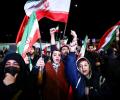
'American stature has been reduced because they have not been able to achieve their aims.'

China's Foreign Ministry has refuted allegations of providing military support to Iran, warning the US against imposing tariffs based on these accusations. The statement follows reports of Iran acquiring a Chinese satellite for targeting US military bases. Meanwhile, a rescheduled meeting between Presidents Trump and Xi Jinping is set for May.

Chinese Foreign Minister Wang Yi has urged Iran to guarantee freedom and safe passage through the Strait of Hormuz, a critical waterway for global oil trade, amid ongoing tensions with the US.

US Secretary of State Marco Rubio on Friday (local time) announced a US-mediated framework agreement between Israel and Lebanon aimed at achieving "lasting peace and security".

This sharp Iranian response came after a series of uncompromising remarks from the US president.

Trump's message, posted on his Truth Social platform, is a reminder of his 10-day ultimatum given to the Islamic Republic earlier to make progress toward a deal or reopen the vital shipping lane.

Iran has submitted a fresh proposal to regional intermediaries offering to cease its military operations in the Strait of Hormuz, contingent upon a complete cessation of hostilities and the removal of the US blockade on Iranian maritime hubs.

For India, much is at stake: Crucial energy supplies traversing the Strait of Hormuz, the fate of its 10 million citizens living and working in West Asia -- who send generous remittances home -- and its major trade links with the region.

The United States Central Command (CENTCOM) has announced that American forces are maintaining a strict maritime restrictive operation in the region, continuing to enforce a blockade against Iranian ports.

Pakistan's Prime Minister Shehbaz Sharif has welcomed the ceasefire between the US and Iran and invited delegations from both countries to Islamabad for peace negotiations.

Donald Trump says several issues were settled during the final day of talks with Xi Jinping covering trade, tariffs, and diplomacy.

Iran has lodged a formal complaint with the United Nations, accusing the US of engaging in 'piracy' following the seizure of Iranian vessels. The complaint was detailed in a letter sent by Iran's UN envoy to the UN Secretary-General and the Security Council.

The United States' historical strategic alignment with Pakistan, dating back to the Cold War, has consistently aimed to create a political and military parity with India, despite India's significantly larger size and resources. This long-standing relationship continues to influence regional dynamics, particularly in West Asia and the Indo-Pacific.
